Thursday, February 9, 2012


Friday, February 25, 2011
Egypt: 18 days that shook the world
---

In the early afternoon of January 25th 2011, I found myself on the Nile corniche north of Qasr El-Nile bridge, alongside about a thousand pro-change protesters. My companions and I had already been watching extraordinary scenes unfold across the city all morning, particularly in the populous northern neighbourhoods of Bulaq and Shubra El-Masr, where small, mobile crowds of demonstrators swept through the streets with astonishing ease, chanting 'down, down Hosni Mubarak' and exposing a simple but explosive truth to nonplussed bystanders: behind the facade of a supposedly-impregnable security apparatus, there really was nothing to stop Egyptians standing up for their rights and making their voices heard.
Mubarak's security forces were taken by surprise that day; thinly-strung and overstretched, they were powerless to stop the dozens of parallel demonstrations erupting all over the capital and beyond. By early afternoon though, they had rallied, and were now stationed in their hundreds across the road in front of the derelict Nile Hilton - rows of amin markazi, helmeted and shielded to the bone. The protesters didn't charge, didn't fight, didn't flinch - they just kept on marching, heads up and eyes forward. And against the sheer weight of human fearlessness, the security forces melted away. At that moment my newspaper called me and asked for an update.
I remember looking around me at the gleeful abandon of demonstrators running from one part of the street to another - revelling in the giddy sensation of having reclaimed their public space from the state. I saw the uncertainty and terpidation etched onto the faces of senior police officers, and at the new columns of protesters streaming in from across the river. And I knew then with absolute certainty that for Mubarak, nothing was left. I didn't know how long it would take, or what horrific violence might unfold in the interim, but a fear barrier had been broken, and for a president whose power rested solely on a bed of fear - fear of the police, fear of the government, fear of extremism, fear of instability - this could only mean the end. 'A revolution has begun,' I told my editors.
18 days later, on February 11th, newly-appointed vice president Omar Suleiman appeared on state television for twenty seconds and announced that Mubarak was stepping down. This is a summary of my writing throughout that period, as our emotions fizzed about like home-made firecrackers and Egyptians took it upon themselves to not just knock something down, but build something new in its stead as well, something that would inspire and amaze well beyond the country's borders. This unfinished revolution has a long and turbulent road ahead, but that only makes the steps taken so far all the more incredible.
Many of the articles below were written with colleagues, including Peter Beaumont and Chris McGreal. Photos are taken from The Atlantic.
Sunday 23rd January
Egypt's young wait for their lives to begin - and dream of revolution (The Observer)
In Cairo, as in places all over the country, all eyes are fixed on the drama that is unfolding in Tunisia. Jack Shenker travelled across Egypt and heard people increasingly asking: could it happen here?
Monday 24th January
Egypt braced for 'day of revolution protests (The Guardian)
Youth activists, Islamists, workers and football fans to hold rallies and marches against Mubarak government
--- 18 days ---


Tuesday 25th January
Mubarak regime in crisis as biggest anti-government demonstrations in a generation sweep across Egypt (The Guardian)
Guardian live blog - January 25th
Wednesday 26th January
Bloodied and bruised: An eyewitness account from inside Mubarak's security apparatus (The Guardian)
The Guardian's man in Cairo tells of his beating and arrest at the hands of the security forces
Egypt protesters prepare to return to the streets (The Guardian)
Guardian live blog - January 26th
Thursday 27th January
Egypt braces itself for biggest day of protests yet (The Guardian)
Pressure builds on the president, Hosni Mubarak, as banned Muslim Brotherhood backs protests
Mohamed ElBaradei lands in Cairo: 'There's no going back' (The Guardian)
Supporters insist Egypt's people will make change from below
Guardian live blog - January 27th
Friday 28th January
Egyptian protesters are not just facebook revolutionaries (The Guardian)
The internet has galvanised dissidents, but the key events that fuelled the uprising happened offline
Egyptian government on last legs, says ElBaradei (The Guardian)
Exclusive: Mohamed ElBaradei says he is sending a message 'to the Guardian and to the world'
Hosni Mubarak orders curfew as protests continue (The Guardian)
• Soldiers told to restore order as violent clashes continue • Mohamed ElBaradei placed under house arrest • Many police switching sides and joining protests
Egypt on the brink as the tanks roll in (The Guardian)
• At least 25 killed on day of violent protest • Mubarak stays but dismisses government • Demonstrators defy nationwide curfew
Guardian live blog - January 28th
Saturday 29th January
Egypt's day of fury: Cairo in flames as cities become battlegrounds (The Guardian)
Guardian live blog - January 29th
Sunday 30th January

Hosni Mubarak in frantic bid to cling on to power (The Observer)
President appoints intelligence chief to vice-president post as streets ring out to cry of 'Mubarak, your plane is ready'
'Mubarak must fall' - across Cairo, the protesters' message is the same (The Observer)
Sacrificing government ministers is not enough: for the people to be satisfied, the president must be deposed
From the young to the old, the voices of the Egyptian rebellion rise (The Observer)
'The youth are motivated to keep going, and the old political leaders have been left behind'
Change is coming, says Mohamed ElBaradei (The Guardian)
Thousands rally in Cairo to defy curfew as Hillary Clinton calls on Hosni Mubarak to allow 'orderly transition'
The mosque that became a hospital (The Guardian)
Egyptians form makeshift militias as police stay off the streets (The Guardian)
Friend or foe? Egypt's army keeps protesters guessing (The Guardian)
Guardian live blog - January 30th
Monday 31st January
Egypt set for mass protest as army rules out force (The Guardian)
Military issues statement via state-run agency on a dramatic seventh consecutive day of unrest
The Muslim Brotherhood: protesters play down Islamist party's role (The Guardian)
Opposition movement vows to 'respect the will of the people' if Mubarak's regime falls
Guardian live blog - January 31st
Tuesday 1st February
Protesters refuse to leave the streets until Mubarak steps down (The Guardian)
Emboldened by the army's support, people pour on to the streets to demand the president's departure
Hosni Mubarak vows to step aside - but not until next election (The Guardian)
Egyptian President Hosni Mubarak's announcement that he will serve out remaining term immediately rejected by angry crowds
Protesters react angrily to Mubarak's televised address (The Guardian)
Opposition parties reject talks with government in effort to shore up credibility (The Guardian)
The president vs the people (Monocle)
Guardian live blog - 1st February
Wednesday 2nd February
Protests show signs of division as Mubarak drives a wedge (The Guardian)
Bloodshed in Tahrir: Mubarak supporters stage brutal bid to crush Cairo uprising (The Guardian)
Egyptian president's regime orchestrates bloody battles in Tahrir Square against protesters seeking his removal from power
Egypt's revolution turns ugly as Mubarak fights back (The Guardian)
Extraordinary scenes in central Cairo and violent battles in cities across the country
Mubarak's thugs fight for Tahrir Square (The Guardian)
Claims that plainclothes police hidden in ranks as battles take place in the symbolic epicentre of the revolution
ElBaradei urges world leaders to abandon Mubarak (The Guardian)
Criminal acts by government-backed thugs and a regime killing its own people make negotiations impossible, says Nobel laureate
Guardian live blog - February 2nd
Thursday 3rd February
Cairo protesters face more gunfire (The Guardian)
Death toll rises as violent clashes continue in Egypt between anti-government and pro-Mubarak supporters
Egyptian army disperses Mubarak supporters from key bridge (The Guardian)
Tahrir Square battleground: 'These people tried to slaughter us last night' (The Guardian)
Anti-Mubarak protesters in Cairo fight to hold square littered with bricks and burnt-out vehicles after night of bloodshed
Guardian live blog - February 3rd
Friday 4th February
US hatches Mubarak exit strategy as Egypt death toll mounts (The Guardian)
White House involved in discussions to remove Egyptian president, in spite of Mubarak claims that he is on staying on
'You come near Tahrir again and things won't be so good' (The Guardian - written by Peter Beaumont)
Guardian reporters have hair-raising encounters with the Egyptian security forces and an angry mob
Cairo's biggest protest yet demands Mubarak's immediate departure (The Guardian)
Egyptian president clings to power as hundreds of thousands stage 'day of departure' demonstration in Tahrir Square
Guardian live blog - February 4th
Saturday 5th February
Mubarak's departure will not be enough to quell uprising (The Guardian)
Egypt protests: government will meet key opposition figures (The Guardian)
Talks to begin with newly appointed vice-president Omar Suleiman as protests run into 12th day
Guardian live blog - February 5th
Sunday 6th February
The Tahrir Square medic (The Guardian)
Cardiologist Dina Omar shares her experience of treating injured protesters in makeshift medical camp as rocks and petrol bombs were thrown at them
Guardian live blog - February 6th
Monday 7th February
Business as usual for Egypt's rich - but their children are out protesting (The Guardian)
In New Cairo – a satellite city to the east of the capital – life, on the surface at least, seems to have barely changed
Guardian live blog - February 7th
Tuesday 8th February
The Muslim Brotherhood uncovered (The Guardian)
In an exclusive Guardian interview, Egypt's Islamist opposition group sets out its demands
Guardian live blog - February 8th
Wednesday 9th February
Egyptian talks near collapse as unions back protesters (The Guardian)
Government refuses transition plan as demonstrations are joined by strikes – and vice-president's coup ultimatum raises tensions
Guardian live blog - February 9th
Thursday 10th February
Egypt's economy suffers as strikes intensify (The Guardian)
Thousands of workers walked out from their jobs, piling pressure on a political leadership already rocked by protests
Egypt: Day of rumour and expectation ends in anger and confusion (The Guardian)
Vast crowds in Tahrir Square expected a victory party after the departure of Mubarak – but it was not to be
Guardian live blog - February 10th
Friday 11th February

Protesters surround state TV building (The Guardian)
Opposition protest blocks streets around pro-Mubarak symbol of power in bid to stop journalists inside 'spreading more deception'
Hosni Mubarak resigns - and Egypt celebrates a new dawn (The Guardian)
President Mubarak surrenders power to army and flies out of Cairo as 18 days of mass protest in Egypt end in revolution
Tahrir: In Cairo's liberation square, the victory party begins (The Guardian)
Jubilant Egyptians push aside fear of future and celebrate Hosni Mubarak's resignation

Guardian live blog - February 11th
Guardian live blog - Mubarak resigns
Mubarak regime in crisis as biggest anti-government demonstrations in a generation sweep across Egypt (The Guardian)
Guardian live blog - January 25th
Wednesday 26th January
Bloodied and bruised: An eyewitness account from inside Mubarak's security apparatus (The Guardian)
The Guardian's man in Cairo tells of his beating and arrest at the hands of the security forces
Egypt protesters prepare to return to the streets (The Guardian)
Guardian live blog - January 26th
Thursday 27th January
Egypt braces itself for biggest day of protests yet (The Guardian)
Pressure builds on the president, Hosni Mubarak, as banned Muslim Brotherhood backs protests
Mohamed ElBaradei lands in Cairo: 'There's no going back' (The Guardian)
Supporters insist Egypt's people will make change from below
Guardian live blog - January 27th
Friday 28th January
Egyptian protesters are not just facebook revolutionaries (The Guardian)
The internet has galvanised dissidents, but the key events that fuelled the uprising happened offline
Egyptian government on last legs, says ElBaradei (The Guardian)
Exclusive: Mohamed ElBaradei says he is sending a message 'to the Guardian and to the world'
Hosni Mubarak orders curfew as protests continue (The Guardian)
• Soldiers told to restore order as violent clashes continue • Mohamed ElBaradei placed under house arrest • Many police switching sides and joining protests
Egypt on the brink as the tanks roll in (The Guardian)
• At least 25 killed on day of violent protest • Mubarak stays but dismisses government • Demonstrators defy nationwide curfew
Guardian live blog - January 28th
Saturday 29th January
Egypt's day of fury: Cairo in flames as cities become battlegrounds (The Guardian)
Guardian live blog - January 29th
Sunday 30th January

Hosni Mubarak in frantic bid to cling on to power (The Observer)
President appoints intelligence chief to vice-president post as streets ring out to cry of 'Mubarak, your plane is ready'
'Mubarak must fall' - across Cairo, the protesters' message is the same (The Observer)
Sacrificing government ministers is not enough: for the people to be satisfied, the president must be deposed
From the young to the old, the voices of the Egyptian rebellion rise (The Observer)
'The youth are motivated to keep going, and the old political leaders have been left behind'
Change is coming, says Mohamed ElBaradei (The Guardian)
Thousands rally in Cairo to defy curfew as Hillary Clinton calls on Hosni Mubarak to allow 'orderly transition'
The mosque that became a hospital (The Guardian)
Egyptians form makeshift militias as police stay off the streets (The Guardian)
Friend or foe? Egypt's army keeps protesters guessing (The Guardian)
Guardian live blog - January 30th
Monday 31st January
Egypt set for mass protest as army rules out force (The Guardian)
Military issues statement via state-run agency on a dramatic seventh consecutive day of unrest
The Muslim Brotherhood: protesters play down Islamist party's role (The Guardian)
Opposition movement vows to 'respect the will of the people' if Mubarak's regime falls
Guardian live blog - January 31st
Tuesday 1st February
Protesters refuse to leave the streets until Mubarak steps down (The Guardian)
Emboldened by the army's support, people pour on to the streets to demand the president's departure
Hosni Mubarak vows to step aside - but not until next election (The Guardian)
Egyptian President Hosni Mubarak's announcement that he will serve out remaining term immediately rejected by angry crowds
Protesters react angrily to Mubarak's televised address (The Guardian)
Opposition parties reject talks with government in effort to shore up credibility (The Guardian)
The president vs the people (Monocle)
Guardian live blog - 1st February
Wednesday 2nd February
Protests show signs of division as Mubarak drives a wedge (The Guardian)
Bloodshed in Tahrir: Mubarak supporters stage brutal bid to crush Cairo uprising (The Guardian)
Egyptian president's regime orchestrates bloody battles in Tahrir Square against protesters seeking his removal from power
Egypt's revolution turns ugly as Mubarak fights back (The Guardian)
Extraordinary scenes in central Cairo and violent battles in cities across the country
Mubarak's thugs fight for Tahrir Square (The Guardian)
Claims that plainclothes police hidden in ranks as battles take place in the symbolic epicentre of the revolution
ElBaradei urges world leaders to abandon Mubarak (The Guardian)
Criminal acts by government-backed thugs and a regime killing its own people make negotiations impossible, says Nobel laureate
Guardian live blog - February 2nd
Thursday 3rd February
Cairo protesters face more gunfire (The Guardian)
Death toll rises as violent clashes continue in Egypt between anti-government and pro-Mubarak supporters
Egyptian army disperses Mubarak supporters from key bridge (The Guardian)
Tahrir Square battleground: 'These people tried to slaughter us last night' (The Guardian)
Anti-Mubarak protesters in Cairo fight to hold square littered with bricks and burnt-out vehicles after night of bloodshed
Guardian live blog - February 3rd
Friday 4th February
US hatches Mubarak exit strategy as Egypt death toll mounts (The Guardian)
White House involved in discussions to remove Egyptian president, in spite of Mubarak claims that he is on staying on
'You come near Tahrir again and things won't be so good' (The Guardian - written by Peter Beaumont)
Guardian reporters have hair-raising encounters with the Egyptian security forces and an angry mob
Cairo's biggest protest yet demands Mubarak's immediate departure (The Guardian)
Egyptian president clings to power as hundreds of thousands stage 'day of departure' demonstration in Tahrir Square
Guardian live blog - February 4th
Saturday 5th February
Mubarak's departure will not be enough to quell uprising (The Guardian)
Egypt protests: government will meet key opposition figures (The Guardian)
Talks to begin with newly appointed vice-president Omar Suleiman as protests run into 12th day
Guardian live blog - February 5th
Sunday 6th February
The Tahrir Square medic (The Guardian)
Cardiologist Dina Omar shares her experience of treating injured protesters in makeshift medical camp as rocks and petrol bombs were thrown at them
Guardian live blog - February 6th
Monday 7th February
Business as usual for Egypt's rich - but their children are out protesting (The Guardian)
In New Cairo – a satellite city to the east of the capital – life, on the surface at least, seems to have barely changed
Guardian live blog - February 7th
Tuesday 8th February
The Muslim Brotherhood uncovered (The Guardian)
In an exclusive Guardian interview, Egypt's Islamist opposition group sets out its demands
Guardian live blog - February 8th
Wednesday 9th February
Egyptian talks near collapse as unions back protesters (The Guardian)
Government refuses transition plan as demonstrations are joined by strikes – and vice-president's coup ultimatum raises tensions
Guardian live blog - February 9th
Thursday 10th February
Egypt's economy suffers as strikes intensify (The Guardian)
Thousands of workers walked out from their jobs, piling pressure on a political leadership already rocked by protests
Egypt: Day of rumour and expectation ends in anger and confusion (The Guardian)
Vast crowds in Tahrir Square expected a victory party after the departure of Mubarak – but it was not to be
Guardian live blog - February 10th
Friday 11th February

Protesters surround state TV building (The Guardian)
Opposition protest blocks streets around pro-Mubarak symbol of power in bid to stop journalists inside 'spreading more deception'
Hosni Mubarak resigns - and Egypt celebrates a new dawn (The Guardian)
President Mubarak surrenders power to army and flies out of Cairo as 18 days of mass protest in Egypt end in revolution
Tahrir: In Cairo's liberation square, the victory party begins (The Guardian)
Jubilant Egyptians push aside fear of future and celebrate Hosni Mubarak's resignation

Guardian live blog - February 11th
Guardian live blog - Mubarak resigns
--- Aftermath ---
Egypt: How the wheel of history turned (The Observer)
By overcoming their fears and defying the man whose regime had terrorised them for 30 years, Cairo's protesters not only drove out Hosni Mubarak, they have changed the Arab world
Monday 14th February
Young Arabs throwing off the shackles of tradition (The Guardian)
The frustrated generation at the heart of the protests tell how their progress is being stifled by unemployment, corruption and cronyism
Egyptian protester: Tunisia shows us something different was possible (The Guardian)
Frustrated Cairo graduate Shady Alaa El Din wanted to leave Egypt because of the lack of freedom and opportunity, but protests in Tahrir Square have made him feel capable of bringing change
Tuesday 15th February
Egypt's army hijacking revolution, activists fear (The Guardian)
Military ruling council begins to roll out reform plans while civilian groups struggle to form united front
Wednesday 16th February
Egyptian activists condemn brutal attack on CBS reporter in Tahrir Square (The Guardian)
Serious assault on Lara Logan of CBS took place in middle of crowd at height of celebrations after Hosni Mubarak resigned
Monday 21st February
Egypt's press undergoes its own revolution (Media Guardian)
Does the political upheaval in Egypt spell the end of state-controlled media?
The revolution, violence and KFC: In conversation with Abdel Latif Al Menawy
Transcript from interview with the head of Egyptian state news
Tuesday 22nd February
Arab League urged to condemn Gaddafi by angry protesters in Egypt (The Guardian)
Demonstrators outside Arab League headquarters in Cairo accuse members of being out of touch
Thursday 24th February
Mubarak's cronies face corruption charges in Cairo court (The Guardian)
Three stalwarts of the deposed Egyptian president are greeted by angry crowd at courthouse
Saudi king accused of misjudged bribery in attempt to stave off unrest (The Guardian)
King Abdullah needs to implement political reform, scholars claim, as students plan 'day of rage'
Sunday 27th February
Egypt general's unveil reform package (The Guardian)
Interim government's committee of experts proposes eight changes to constitution
Monday 28th February
Hosni Mubarak barred from leaving Egypt (The Guardian)
Attorney general announces travel ban and freeze on Hosni Mubarak's domestic assets in possible prelude to prosecution
Wednesday 2nd March
Egypt's revolution: The T-shirts, the tat, and the tremendous struggle that continues (Monocle)
---

By overcoming their fears and defying the man whose regime had terrorised them for 30 years, Cairo's protesters not only drove out Hosni Mubarak, they have changed the Arab world
Monday 14th February
Young Arabs throwing off the shackles of tradition (The Guardian)
The frustrated generation at the heart of the protests tell how their progress is being stifled by unemployment, corruption and cronyism
Egyptian protester: Tunisia shows us something different was possible (The Guardian)
Frustrated Cairo graduate Shady Alaa El Din wanted to leave Egypt because of the lack of freedom and opportunity, but protests in Tahrir Square have made him feel capable of bringing change
Tuesday 15th February
Egypt's army hijacking revolution, activists fear (The Guardian)
Military ruling council begins to roll out reform plans while civilian groups struggle to form united front
Wednesday 16th February
Egyptian activists condemn brutal attack on CBS reporter in Tahrir Square (The Guardian)
Serious assault on Lara Logan of CBS took place in middle of crowd at height of celebrations after Hosni Mubarak resigned
Monday 21st February
Egypt's press undergoes its own revolution (Media Guardian)
Does the political upheaval in Egypt spell the end of state-controlled media?
The revolution, violence and KFC: In conversation with Abdel Latif Al Menawy
Transcript from interview with the head of Egyptian state news
Tuesday 22nd February
Arab League urged to condemn Gaddafi by angry protesters in Egypt (The Guardian)
Demonstrators outside Arab League headquarters in Cairo accuse members of being out of touch
Thursday 24th February
Mubarak's cronies face corruption charges in Cairo court (The Guardian)
Three stalwarts of the deposed Egyptian president are greeted by angry crowd at courthouse
Saudi king accused of misjudged bribery in attempt to stave off unrest (The Guardian)
King Abdullah needs to implement political reform, scholars claim, as students plan 'day of rage'
Sunday 27th February
Egypt general's unveil reform package (The Guardian)
Interim government's committee of experts proposes eight changes to constitution
Monday 28th February
Hosni Mubarak barred from leaving Egypt (The Guardian)
Attorney general announces travel ban and freeze on Hosni Mubarak's domestic assets in possible prelude to prosecution
Wednesday 2nd March
Egypt's revolution: The T-shirts, the tat, and the tremendous struggle that continues (Monocle)
---

---
Monday, February 21, 2011
State media, the revolution and violence: In conversation with Abdel Latif Al-Menawy
---

I interviewed Mr Al Menawy for a general story about the state media in post-Mubarak Egypt, which can be read here. Unfortunately there wasn't room in the article to include all of Mr Al Menawy's comments, which were made over a back-and-forth email exchange on the 17th-18th February 2011, so I have published the full unedited exchange here, copied and pasted from the emails.
---
Jack Shenker: How do you think the state media, and in particular state television, performed in its initial coverage of the recent anti-government protests?Abdel Latif Al-Menawy: The state media tried as much as possible not to be part of any demonstrations but to be neutral. We were very keen to only put the accurate news and at the same time show our audience the two different points of views. But to do so we had to investigate every piece of news we received from both parties’ which affected our fast pace of putting the news on air. We gave as much time to the youth of the revolution to explain and criticize and at many times answer back to the government officials who also presented their own points of view. We can only be held responsible for the
material we broadcast as news.
JS: Why did we see the tone of coverage changing in the final week before Hosni Mubarak's departure, becoming more critical of the regime and supportive of demonstrators?
AM: A changing point in our coverage happened Wednesday night the 2nd of February. During that day we received news that we thoroughly checked with our sources then of fireballs being thrown at demonstrators in Tahrir Square. The army even asked us to warn people of the fireballs as they must evacuate the square. At this point when we saw what happened we had to review our position and the accuracy of the news we are getting from our sources. This is where everyone thought we changed our tone.
JS: Does the state media still have credibility in the eyes of the Egyptian people following recent events?
AM: The famous media school of BBC says credibility comes before the scoop. So we had to check every news item before we use it on air. Egypt’s Television played this role very well. We were the main source of news to all the national and international news channels and we were quoted on Alarabyia,CNN,BBC. So we needed to be accurate and as fast as possible. We did not want to reach the point where we start denying our own news, which happened in other channels. These channels were trying to direct the Public opinion regardless of credibility. Credibility was our main aim here.
JS: What is the short-term future now for those holding senior positions in the state media complex, who are facing calls for their resignation by some members of staff?
AM: The great revolution in Tahrir Square which caused the stepping down of the president turned into small revolutions in every Egyptian institution. Any head, starting from the prime minister to the head of any small district is asked to step down too. It is not just the media. Officials who are supposed to resign are the ones who did not work according to the ethics of professionalism and did not play their role in keeping this country united. I believe that we at Egypt’s TV had worked very professionally, and were keen to keep the unity of this country at a time when all the institutions were collapsing.
JS: What is the long term future of the state media if liberalisation of the media market continues and more private competitors begin to emerge? What reforms need to take place to keep state media at the cutting edge?
AM: I always use the term public media when I speak about Egypt’s TV not the state or the government TV, because we are working for the public and not state or the government. The required changes now means that this television needs to keep playing its role in maintaining the unity of the country. And I believe public media will always be there as long as it serves the public. I believe the form and content will change but it will always be the eye of the public and its connection to the state.
JS: Mr Al Menawy - I am a British journalist based in Cairo, and hence part of a group identified by Egyptian state television news as being a 'foreign agent', with alleged links to Hamas, Israel, Iran and the USA. I was also accused of having received free meals from KFC (Kentucky) and of being part of a deliberate plot to stabilise Egypt. Both myself and my colleagues suffered exceptional violence in the streets which I believe was the direct result of these very statements that were put out on your channels. Will you please offer me a personal apology for the part you played in disseminating those lies, and an expression of regret for the violence that arose from them?
AM: Dear Sir - There is nothing personal when it comes to journalism. If you are speaking about the coverage of Egypt's TV during the days of the revolution it is all recorded. After reviewing the tapes I did not find your name, photo, video of you or association of your profession in our coverage. So obviously you were misinformed. You were not the only one who was subjected to violence during the demonstrations. One of our Arabic reporters was stabbed during a phone call on air and another was attacked. Also two of our English reporters were attacked in the demonstrations. We received calls asking for help from foreign reporters on Thursday the 3rd of February. They were being attacked by mob and rounded in Tahrir square and we informed the army right way we even sent some of our security people to help keep them safe they escaped and took cover at Ramses Hilton Hotel and our security and army kept them safe.
Concerning the foreign agents who took free meals from KFC that was not part of our news that came as an opinion in a phone call by viewer and as we believe in free speech we could not cut the caller on air. On the other hand, we gave other callers from Tahrir square the chance to disagree right after and on air also. I hate to tell you that most journalists who have worked in dangerous zones were subjected to violence and if that came as a surprise for you I think you should contact your administration.
Best of luck
JS: Dear Mr Al Menawy - I was not suggesting that I was ever identified personally - to my knowledge neither my name nor organisation was ever specifically referenced on state television, although on the night of the 25th January I was detained and beaten by state security officers and I believe there was some coverage of this in the Egyptian media (this is by no means the fault of state TV though - I mention it merely in passing).
What I am talking about is the general narrative adopted by the state media, including state television news, which in the first week of the revolution (before the baltagiyya attacks in early February) presented the view that foreigners were behind the pro-democracy protests, and that foreign journalists in particular were among the 'foreign agents' inciting unrest. Respectfully sir, I am not misinformed on this point. As you are well aware, the editorial stance of most of the state media, including the television news channels, was initially that foreigners were responsible for the street demonstrations, and were trying to disrupt Egypt - a view that was put forward by the Mubarak government and echoed uncritically in the state media.
The KFC claim may have come from a caller, but it was never investigated or discredited by your journalists and the general tone of state TV news coverage maintained the line that there was outside influence fomenting the anti-government uprising - there were even reports of Israelis being arrested by vigilante groups on the streets of Egypt, a claim that I do not believe has ever been verified as accurate. Nor did you initially give Tahrir square demonstrators the right to air their views in the early days following January 25th, nor did you offer the anti-Mubarak protests anything like the coverage afforded to the pro-Mubarak protests the following week - if you have recordings that indicate the contrary, I would be interested in seeing them.
Within the atmosphere of general uncertainty, uncritically following the government's 'foreign agents' line on the protests without investigating and verifying these claims was, as you must have been aware, certain to create a very dangerous climate for all foreigners in Egypt, journalists or not. I have lived in Egypt for three years and consider this my home - I did not 'fly in' here to cover a war zone. As a matter of fact I have reported from many violent locations, including Gaza during the last Israeli assault there, so I am hardly surprised at or unaccustomed to violence in my work. But this is irrelevant: once the police left the streets on January 28th, Cairo was not a warzone - that is until the government, supported by the state media, began to accuse the protesters of being backed by foreign powers. The result was that foreigners (and many more Egyptians) were attacked, some very seriously.
It is not unreasonable to expect the government of the country you live in not to fabricate misinformation about people from certain countries and people who do certain jobs, nor is it unreasonable to question why any responsible media professional would repeat those fabrications in the knowledge that violent retribution could be a consequence. If you don't wish to acknowledge or apologise for the role played in this by the news output on your channels then so be it, I merely wished to offer you the opportunity. I commend you for the help you offered foreign reporters on the 3rd February, although by that stage the damage had been done, and I stand in solidarity with all those journalists and Egyptians who were killed and wounded in the uprising - please don't ever question me on that.
Kind regards, Jack
At this point, Mr Al Menawy stopped responding.
Sunday, February 13, 2011
Egypt: How the wheel of history turned
By overcoming their fears and defying the man whose regime had terrorised them for 30 years, Cairo's protesters not only drove out Hosni Mubarak, they have changed the Arab world

-Taken from the Observer (with David Sharrock and Paul Harris)
-Cairo - February 2011
There is a tide in the affairs of men which, taken at the flood, leads on to fortune, says Brutus in Shakespeare's Julius Caesar as he urges his comrades to seize the moment to overthrow the ruler they see as a tyrant. It has taken decades for the storm surge to break over Egypt, but when it finally did the forces of change proved irresistible, sweeping away Hosni Mubarak in just 18 days of popular and peaceful street protests.
A first draft of why it happened must begin in a rural town in Tunisia on the shores of the Mediterranean where Mohamed Bouazizi was the unlikeliest catalyst of the extraordinary realignment in the region.
Known locally as Basboosa, Mohamed, aged 26, was a street fruit vendor in Sidi Bouzid, where unemployment is conservatively estimated at 30%. He earned around £87 a month, the money going to support his six siblings, including one sister in university. He was regularly stopped by police, who expected him to pay them bribes to allow him to sell his wares from a wheelbarrow. On the morning of 17 December last year he had spent the equivalent of £125 on merchandise when it was seized.
What made the loss harder to take was the humiliation. A 45-year-old female officer slapped him across the face, spat at him, scattered his fruit on the ground and confiscated his electronic scales. Two of her colleagues joined in, beating him. As a coup de grace, the woman insulted Mohamed's dead father, a labourer who died of a heart attack when his eldest son was just three years old.
Mohamed finally snapped. For decades millions of young men like him right across the North African coastal plain have watched television images beamed from the other side of the Mediterranean from a European continent of prosperity, freedom and opportunity. They have watched the cronies of their own regimes growing older and, in their decadence, more arrogant and corrupt. They have watched hope for a better future leaking away.
Seeking justice, Mohamed went to the local governor's office to complain about his treatment. He issued a warning when told that the governor was unavailable: "If you don't see me, I'll burn myself." At 11.30am, less than an hour after he had been robbed and humiliated by the state's forces, he doused himself in petrol in front of the governor's office and set himself alight.
"What kind of repression do you imagine it takes for a young man to do this?" said his sister Samia when her brother finally died of horrific injuries on 4 January. "A man who has to feed his family by buying goods on credit when they fine him ... and take his goods. In Sidi Bouzid, those with no connections and no money for bribes are humiliated and insulted and not allowed to live."
The young man's desperate action was a rallying call long awaited in his country and its neighbours. Mohamed Bouazizi's death became the spark which lit the bonfire on which the corrupt regime of Tunisia's President Zine al-Abidine Ben Ali would also perish. And, like a bushfire out of control, there was soon fears that the "contagion" would spread.
In an eerie coincidence with subsequent events in Egypt, it took 18 days for Mohamed to die, during which time Ben Ali was sufficiently shaken by the growing voices of anger and protest that he visited the dying young man in hospital.
At his funeral 5,000 mourners chanted: "Farewell, Mohamed, we will avenge you. We weep for you today. We will make those who caused your death weep." He was buried at Garaat Bennour cemetery, 10 miles from Sidi Bouzid.
By then there was no turning back for the old guard as riots in Sidi Bouzid spread to the capital, Tunis. It seemed miraculous to Tunisians how quickly the iron fist of Ben Ali, president for 24 years, was loosened. The internet played a vital role, subverting the state-controlled communications channels by allowing ordinary citizens to bypass them and organise democratically.
"Game Over!" taunted the placards and cheers of the jubilant crowds in a deliberate reference to the age of online computer gaming – a world beyond the reach of ageing tyrants, where the sans culottes of the Arab world come together in cyberspace.
For decades Tunisia had been characterised by the west as a "model" Arab nation, but the WikiLeaks saga, months earlier, revealed the ugly truth of what its key sponsor, the United States, really thought of this "mafia state", run as a virtual private enterprise by Ben Ali and his hated, avaricious wife Leila Trabelsi, who plundered 1.5 tonnes of gold from the central bank when they fled to Jeddah in Saudi Arabia.
Ben Ali's removal from power suddenly seemed to be creating a potential domino-effect around the region. First he tried to quell the protests by addressing the nation on state television and promising reforms. But when this failed to stem the tide of opposition, and with confidence among the armed forces ebbing from him, he chose to run. An international arrest warrant has been issued by Tunisia and his assets in Swiss banks have been frozen.
While opposition figures, including a leading internet activist, have joined an interim government in preparation for elections within two months, the situation in Tunisia remains highly fluid and volatile, with most ordinary citizens unhappy that so many leading lights of the old regime remain in power.
The results of Mohamed Bouazizi's self-immolation swiftly prompted protests across the region. Inspired by Tunisia's Jasmine Revolution, large protests began in Algeria, Yemen, Jordan and Egypt, with lesser incidents in Mauritania, Saudi Arabia, Sudan, Oman, Syria, Iraq, Lebanon, Libya and Morocco. Many were characterised by a playful, party atmosphere. In Amman, the Jordanian security forces handed out soft drinks to protesters, who laughed as they chanted "Mubarak you are next!"
The Jordanians could not have known they were right. But to fully comprehend the swirling fury of the Egyptian street one must look back nine months. It was near midnight on Sunday 6 June when two Egyptian police officers walked into the Space Net internet cafe on Boubaset Street, a short stroll from Alexandria's crumbling corniche, and demanded to speak to Khaled Said.
According to his mother and sister, Said, 28, was devoted to his pet cats and enjoyed pacing the seafront, flying kites on his own. His room was a jumble of wires and old car batteries, part of a homemade music system Said used to practise rapping; the thumping bass from behind his door could often be heard well into the early hours.
"He was ordinary, like any one of us," remembers his sister, Zahraa. "He never seemed interested in politics at all."
That night Khaled Said was beaten to death by the two officers who came looking for him. They smashed his head against a marble ledge in the lobby of the building next door before throwing his body into the back of a van, driving around, then dumping it by the roadside. It later emerged that Said had taped a secret video depicting what appeared to be corrupt local security chiefs dividing up the spoils of a drugs bust. His family also discovered self-penned anti-government songs stored on his computer.
Three months ago, in the run-up to Egypt's blatantly rigged parliamentary elections, Zahraa told the Observer that the suffering of her brother and others like him could end up shaking the country to its very foundations: "Change will not come from this regime's version of democracy, it will come in the shape of a tidal wave from below. Maybe the torture and murders carried out by our policemen will set that tidal wave in motion." Her words were prescient.
Khaled Said was not the first Egyptian killed at the hands of Mubarak's police force, nor would he be the last. In Said's Sidi Gabr neighbourhood alone, dozens of police torture cases have been logged by local activists over the past eight months, some of them fatal.
But the brazen manner of this particular murder – on a public street and not behind the blacked-out windows of the Sidi Gabr police headquarters – and the fact that the victim was middle-class, with relatives able to resist pressure from the security services to keep quiet, ensured that the name of Khaled Said quickly become synonymous with the staggering brutality and corruption of Mubarak's vast security apparatus, a brutality and corruption to which almost all Egyptians, to a lesser degree, were exposed on a daily basis.
"That was the turning point," claims Heba Morayef, the Human Rights Watch advocate in Egypt. "Prior to that, demonstrations in favour of political reform struck many ordinary Egyptians as somewhat abstract, even if they had vague sympathy with the sentiments being expressed.
"Police cruelty, however, was something that touched people personally and it inspired a whole new, cross-class section of society to adopt a more combative stance towards the state."
After much dithering and buck-passing by the authorities, the two officers responsible (though not their seniors) were put on trial and mass protests in major cities began. The demonstrations were never more than a few thousand strong, and often smaller – not insignificant in a country where a 30-year-old emergency law effectively criminalises any sort of public expression of dissent, but not enough to panic Mubarak's entrenched political elite.
Online, however, it was a different story. Kolina Khaled Said, a Facebook group meaning "We are all Khaled Said", quickly gathered hundreds of thousands, of supporters, who swapped information on other examples of inhumane police treatment and helped organise small-scale acts of civil disobedience.
Along with a loose network of more explicitly political online activist groups, the anonymous administrators behind Kolina Khaled Said – one of whom turned out to be Google's regional marketing executive, Wael Ghonim, who attended to the web page from his home 1,500 miles away in Dubai – tried to find creative ways to get round Egypt's suffocating legal prohibitions on collective action in an effort to make their voices heard on the ground.
Sometimes small groups of youths would "spontaneously" gather in city centres and sing the national anthem; on other occasions individuals wearing black would walk to the Nile at an appointed hour across the country and stand separately by the river in silence, an innocent routine that still managed to provoke a violent response from the security services.
A critical role in the process was played by another online entity, the 6th April youth movement. Taking its name from the date of a 2008 textile workers’ strike in the Nile Delta town of Mahalla Al-Kubra that left three people dead after central security forces opened fire on the crowds, 6th April formed a new bridge between a predominantly young, well-educated generation of urban political campaigners and a rapidly-proliferating wave of labour activism that was already bringing hundreds of thousands of working-class Egyptians into conflict with an unresponsive state over rising unemployment, spiralling prices and an insultingly meagre minimum wage.
“The coordination between those groups had always been lacking before, even though at the root of it all we had the same complaints,” recalls Ahmed Salah, a veteran activist and co-founder of 6th April. “The challenge became to expose the relevance of our separate struggles to each other. We knew that if we could that, everything would be different.”
Although many of them used the internet as an organisational tool themselves, the struggle of Egyptian workers – who sought to obtain their economic rights from a government that had pushed almost half the population below the poverty line through an aggressive series of neoliberal reforms – had often appeared divorced from that of the ‘facebook activists’ so adored by a buzzword-hungry international media. The latter’s genealogy lay in the Kifaya (‘Enough’) pro-democracy movement that peaked in 2005 around the time of Mubarak’s stage-managed re-election, and focused on constitutional reform and an end to the Emergency Law.
Workers’ demands, which included the ability to establish their own trade unions, free from the control of state-backed labour syndicates, seemed more parochial by comparison. Yet taken together the movements offered a substantial challenge to the legitimacy of the Mubarak government, which in its final decade had become characterised by the tight nexus of Egypt’s business and political elite, members of whom were becoming increasingly indistinguishable.
The link-up between 6th April activists and aggrieved workers was not always a smooth one; on the first anniversary of Mahalla’s uprising an online call for a general strike went virtually unheeded. But a spark of collaboration was born, and, for the first time since the early 2000s – when the second Palestinian intifada and America’s invasion of Iraq brought mass protests to Tahrir Square – a loosely coordinated grassroots assault on Egypt’s political overlords appeared to be taking shape.
This vague but energetic new wave of dissent was leaving behind the moribund landscape of formal opposition politics in Egypt, where paper-democrats had long been scrabbling for crumbs of power tossed down by a regime keen to keep up the facade of a pluralist democracy. Now a new alternative avenue of resistance was on the cards and it was led from below, by those who had never known anything other than Mubarak's autocratic rule. With a demographic time-bomb ticking below the surface – two-thirds of Egypt's population is below the age of 30, and each year 700,000 new graduates chase 200,000 jobs – conditions were ripe for a social explosion.
Into this combustible mix entered Kolina Khaled Said, the creators of which took great pains to cast their movement as not party-political, not backed by shadowy foreign forces, and dedicated primarily to encouraging Egyptians not to be afraid. The ingredients for massive social unrest may have been falling into place, but still in the way stood the firmest obstacle of all: fear.
Through a prodigious web of overlapping security agencies ranging from armed riot police to plain-clothes informants to the baltagiyya – casually-employed ex-prisoners and local thugs – Mubarak's ruling clique had effectively instilled a sense of hopelessness in an overwhelming proportion of the population, whose instincts lay in avoiding the state, not defying it.
There was never any doubt that frustration at the status quo was deep and potent in every geographical and social corner of Egypt. If ever a critical mass of street protests were to develop and individuals thought the state's gendarmerie was no longer impregnable, it was likely that a full-scale uprising would quickly balloon. Yet something was needed to break down that initial aversion to open disobedience. Tunisia provided it. Arab neighbours had faced down their own security forces and won; perhaps now Egyptians could do the same.
A change of tactics was essential though if the omnipresent state security agencies were to be outwitted; 25 January, the date of a national holiday devoted to celebrating the achievements of the police force, was selected as the "day of rage" to exploit growing public resentment against Mubarak's security forces which had been fuelled so successfully by Kolina Khaled Said.
An umbrella coalition of youth activists formed small cells and spent the preceding weeks meeting in secret, plotting a series of devolved, localised protests designed to put maximum strain on the state security resources.
In Cairo, 20 protest sites in densely populated, largely working-class neighbourhoods were selected and publicised. One extra location, in the warren of back streets of the Giza neighbourhood of Bulaq Al-Duqrur, was never broadcast – and took police completely by surprise.
"Usually we rally in one place and immediately get kettled in by hundreds or thousands of riot police," said Ahmed Salah, who was involved in planning for 25 January.
"This time we were determined to do something different – be multi-polar, fast-moving, and too mobile for the 'amin markazi [central security forces], giving us the chance to walk down hundreds of different roads and show normal passers-by that taking to the streets was actually possible."
The plan worked better than they could ever have imagined. Throughout the capital and across the country, pockets of protest sprung up and overpowered the thinly stretched riot police, who had no choice but to let the marches continue. Later, when the different strands rallied in city centres – including Cairo's symbolic Tahrir Square –the police used guns and tear gas to disperse them.
But it was already too late. By destroying the smokescreen of police invincibility, even for only a few hours, the youths had pierced Mubarak's last line of defence – the fear his subjects felt at the thought of confronting him – and a fatal blow was struck to a 30-year dictatorial regime.
Nevertheless, Mubarak would prove to be a mightier force than Tunisia's Ben Ali. He knew he could rely upon the support of the Americans, who had long granted him premier status in the region not just as guarantor of peace with Israel but also the bulwark against Islamist militancy. And, as a fabled military hero, he was not just the creature of the all-powerful armed forces but for decades their own guarantee of stability and continuity.
It was only as the demonstrators refused to desert Tahrir Square or accept Mubarak's concessions for as long as they fell short of his departure, and as Washington dithered and flip-flopped, that the army began to have its doubts about continuing to back him.
As the protests continued, their largely peaceful, non-sectarian nature also assuaged the concerns of those Egyptians who feared chaos or extremism lay at the heart of the largest anti-government uprising their country had ever seen. It was the all-embracing solidarity and strength of those in Tahrir and other major plazas in the country, and the restraint they showed in the face of violent state-backed provocation, that really saw the demonstrations mushroom into an broad-based, inclusive mass social movement.
Repeatedly over the past two weeks the Obama administration, the State Department, CIA and the Pentagon had been unsettled and confused by the situation in Egypt. Caught unawares at the prospect of the protests actually succeeding, they reacted too slowly, then too quickly and, finally, were rescued by events on the ground.
But few should be surprised; American strategy was caught between a rock and a hard place. There was an urgent need to respond to the pro-democracy movement, but at the same time that movement was aimed at unseating one of America's most trusted Arab allies, a man who had been a friend to five presidents over three decades.
At the start the crisis only rippled slowly through Washington. On 26 January, a day after protests began in Egypt, White House spokesman Robert Gibbs called Egypt a "strong ally". The impression of support for a president whose army soaks up more than one billion dollars of US aid a year was strengthened a day later when vice-president Joe Biden said Mubarak was not a dictator.
American policy appeared in total disarray. Obama's envoy in the crisis, old school diplomat Frank Wisner, travelled to the country. On 5 February he expressed public support for Mubarak staying on, yet such was the confusion in US policymaking now that, mere hours later, both the White House and the State Department disavowed his comments.
As the protests refused to die down after Mubarak said that he would resign in September, US policy hardened again. It coalesced around the figure of new vice-president Omar Suleiman. For American – and Israeli – interests, Suleiman seemed ideal. He was known as a strong man and someone who wanted to preserve the strategic status quo, yet also a figure who had made the right noises, in public at least, about making the transition to democracy.
He was seen as someone who could avoid the nightmare American scenario of a popular anti-Israeli government taking power in Egypt or, worst of all, an Islamist-influenced one.
On 8 February, Biden spoke to Suleiman by phone and stressed the need for an orderly, and swift, transition of power. That convinced many in Washington that it was only a matter of time.
Yet the impact of the Egyptian unrest was spiralling out into the rest of American diplomacy. Last Wednesday Obama spoke to Saudi Arabia's King Abdullah in a reportedly testy exchange in which the ageing Saudi royal argued for Mubarak to not be humiliated. When news of the conversation leaked it created a flurry of speculation that the revolt in Egypt was exposing the weakness of American power.
On Thursday CIA chief Leon Panetta told Congress that he imminently expected Mubarak to announce that he was likely to stand down. As Mubarak took to the TV screens that evening, Obama watched the speech on Air Force One as he made his way back from an event in Michigan.
Yet Mubarak fell short of the expectations of those in Tahrir Square and of the army generals when he announced he was transferring his remaining powers to Suleiman but remaining as president, if in name only to save his pride.
It was a move that stunned many and seemed to threaten a complete unravelling and a blood bath, with the demonstrators noisily hatching plans to march on the presidential palace in the morning, a move which would force the Army, thus far maintaining a politically detached posture, into choosing sides.
And so it did, the military's supreme council shepherding the defeated Mubarak onto a plane to take him to a luxurious internal exile at his Red Sea palace. It was an extraordinary finale to 18 days of rage; the army had staged a coup with the backing of the people.
Like a swan looking graceful on the surface while kicking its legs furiously underneath, Obama was able to take to the airwaves and welcome in the changes. "The wheel of history turned at a blinding pace," Obama said.
The day Khaled Said died, his mother vowed to wear only black in recognition of his death and the system that produced it. Yesterday, following Mubarak's departure, she dressed in white.

-Taken from the Observer (with David Sharrock and Paul Harris)
-Cairo - February 2011
There is a tide in the affairs of men which, taken at the flood, leads on to fortune, says Brutus in Shakespeare's Julius Caesar as he urges his comrades to seize the moment to overthrow the ruler they see as a tyrant. It has taken decades for the storm surge to break over Egypt, but when it finally did the forces of change proved irresistible, sweeping away Hosni Mubarak in just 18 days of popular and peaceful street protests.
A first draft of why it happened must begin in a rural town in Tunisia on the shores of the Mediterranean where Mohamed Bouazizi was the unlikeliest catalyst of the extraordinary realignment in the region.
Known locally as Basboosa, Mohamed, aged 26, was a street fruit vendor in Sidi Bouzid, where unemployment is conservatively estimated at 30%. He earned around £87 a month, the money going to support his six siblings, including one sister in university. He was regularly stopped by police, who expected him to pay them bribes to allow him to sell his wares from a wheelbarrow. On the morning of 17 December last year he had spent the equivalent of £125 on merchandise when it was seized.
What made the loss harder to take was the humiliation. A 45-year-old female officer slapped him across the face, spat at him, scattered his fruit on the ground and confiscated his electronic scales. Two of her colleagues joined in, beating him. As a coup de grace, the woman insulted Mohamed's dead father, a labourer who died of a heart attack when his eldest son was just three years old.
Mohamed finally snapped. For decades millions of young men like him right across the North African coastal plain have watched television images beamed from the other side of the Mediterranean from a European continent of prosperity, freedom and opportunity. They have watched the cronies of their own regimes growing older and, in their decadence, more arrogant and corrupt. They have watched hope for a better future leaking away.
Seeking justice, Mohamed went to the local governor's office to complain about his treatment. He issued a warning when told that the governor was unavailable: "If you don't see me, I'll burn myself." At 11.30am, less than an hour after he had been robbed and humiliated by the state's forces, he doused himself in petrol in front of the governor's office and set himself alight.
"What kind of repression do you imagine it takes for a young man to do this?" said his sister Samia when her brother finally died of horrific injuries on 4 January. "A man who has to feed his family by buying goods on credit when they fine him ... and take his goods. In Sidi Bouzid, those with no connections and no money for bribes are humiliated and insulted and not allowed to live."
The young man's desperate action was a rallying call long awaited in his country and its neighbours. Mohamed Bouazizi's death became the spark which lit the bonfire on which the corrupt regime of Tunisia's President Zine al-Abidine Ben Ali would also perish. And, like a bushfire out of control, there was soon fears that the "contagion" would spread.
In an eerie coincidence with subsequent events in Egypt, it took 18 days for Mohamed to die, during which time Ben Ali was sufficiently shaken by the growing voices of anger and protest that he visited the dying young man in hospital.
At his funeral 5,000 mourners chanted: "Farewell, Mohamed, we will avenge you. We weep for you today. We will make those who caused your death weep." He was buried at Garaat Bennour cemetery, 10 miles from Sidi Bouzid.
By then there was no turning back for the old guard as riots in Sidi Bouzid spread to the capital, Tunis. It seemed miraculous to Tunisians how quickly the iron fist of Ben Ali, president for 24 years, was loosened. The internet played a vital role, subverting the state-controlled communications channels by allowing ordinary citizens to bypass them and organise democratically.
"Game Over!" taunted the placards and cheers of the jubilant crowds in a deliberate reference to the age of online computer gaming – a world beyond the reach of ageing tyrants, where the sans culottes of the Arab world come together in cyberspace.
For decades Tunisia had been characterised by the west as a "model" Arab nation, but the WikiLeaks saga, months earlier, revealed the ugly truth of what its key sponsor, the United States, really thought of this "mafia state", run as a virtual private enterprise by Ben Ali and his hated, avaricious wife Leila Trabelsi, who plundered 1.5 tonnes of gold from the central bank when they fled to Jeddah in Saudi Arabia.
Ben Ali's removal from power suddenly seemed to be creating a potential domino-effect around the region. First he tried to quell the protests by addressing the nation on state television and promising reforms. But when this failed to stem the tide of opposition, and with confidence among the armed forces ebbing from him, he chose to run. An international arrest warrant has been issued by Tunisia and his assets in Swiss banks have been frozen.
While opposition figures, including a leading internet activist, have joined an interim government in preparation for elections within two months, the situation in Tunisia remains highly fluid and volatile, with most ordinary citizens unhappy that so many leading lights of the old regime remain in power.
The results of Mohamed Bouazizi's self-immolation swiftly prompted protests across the region. Inspired by Tunisia's Jasmine Revolution, large protests began in Algeria, Yemen, Jordan and Egypt, with lesser incidents in Mauritania, Saudi Arabia, Sudan, Oman, Syria, Iraq, Lebanon, Libya and Morocco. Many were characterised by a playful, party atmosphere. In Amman, the Jordanian security forces handed out soft drinks to protesters, who laughed as they chanted "Mubarak you are next!"
The Jordanians could not have known they were right. But to fully comprehend the swirling fury of the Egyptian street one must look back nine months. It was near midnight on Sunday 6 June when two Egyptian police officers walked into the Space Net internet cafe on Boubaset Street, a short stroll from Alexandria's crumbling corniche, and demanded to speak to Khaled Said.
According to his mother and sister, Said, 28, was devoted to his pet cats and enjoyed pacing the seafront, flying kites on his own. His room was a jumble of wires and old car batteries, part of a homemade music system Said used to practise rapping; the thumping bass from behind his door could often be heard well into the early hours.
"He was ordinary, like any one of us," remembers his sister, Zahraa. "He never seemed interested in politics at all."
That night Khaled Said was beaten to death by the two officers who came looking for him. They smashed his head against a marble ledge in the lobby of the building next door before throwing his body into the back of a van, driving around, then dumping it by the roadside. It later emerged that Said had taped a secret video depicting what appeared to be corrupt local security chiefs dividing up the spoils of a drugs bust. His family also discovered self-penned anti-government songs stored on his computer.
Three months ago, in the run-up to Egypt's blatantly rigged parliamentary elections, Zahraa told the Observer that the suffering of her brother and others like him could end up shaking the country to its very foundations: "Change will not come from this regime's version of democracy, it will come in the shape of a tidal wave from below. Maybe the torture and murders carried out by our policemen will set that tidal wave in motion." Her words were prescient.
Khaled Said was not the first Egyptian killed at the hands of Mubarak's police force, nor would he be the last. In Said's Sidi Gabr neighbourhood alone, dozens of police torture cases have been logged by local activists over the past eight months, some of them fatal.
But the brazen manner of this particular murder – on a public street and not behind the blacked-out windows of the Sidi Gabr police headquarters – and the fact that the victim was middle-class, with relatives able to resist pressure from the security services to keep quiet, ensured that the name of Khaled Said quickly become synonymous with the staggering brutality and corruption of Mubarak's vast security apparatus, a brutality and corruption to which almost all Egyptians, to a lesser degree, were exposed on a daily basis.
"That was the turning point," claims Heba Morayef, the Human Rights Watch advocate in Egypt. "Prior to that, demonstrations in favour of political reform struck many ordinary Egyptians as somewhat abstract, even if they had vague sympathy with the sentiments being expressed.
"Police cruelty, however, was something that touched people personally and it inspired a whole new, cross-class section of society to adopt a more combative stance towards the state."
After much dithering and buck-passing by the authorities, the two officers responsible (though not their seniors) were put on trial and mass protests in major cities began. The demonstrations were never more than a few thousand strong, and often smaller – not insignificant in a country where a 30-year-old emergency law effectively criminalises any sort of public expression of dissent, but not enough to panic Mubarak's entrenched political elite.
Online, however, it was a different story. Kolina Khaled Said, a Facebook group meaning "We are all Khaled Said", quickly gathered hundreds of thousands, of supporters, who swapped information on other examples of inhumane police treatment and helped organise small-scale acts of civil disobedience.
Along with a loose network of more explicitly political online activist groups, the anonymous administrators behind Kolina Khaled Said – one of whom turned out to be Google's regional marketing executive, Wael Ghonim, who attended to the web page from his home 1,500 miles away in Dubai – tried to find creative ways to get round Egypt's suffocating legal prohibitions on collective action in an effort to make their voices heard on the ground.
Sometimes small groups of youths would "spontaneously" gather in city centres and sing the national anthem; on other occasions individuals wearing black would walk to the Nile at an appointed hour across the country and stand separately by the river in silence, an innocent routine that still managed to provoke a violent response from the security services.
A critical role in the process was played by another online entity, the 6th April youth movement. Taking its name from the date of a 2008 textile workers’ strike in the Nile Delta town of Mahalla Al-Kubra that left three people dead after central security forces opened fire on the crowds, 6th April formed a new bridge between a predominantly young, well-educated generation of urban political campaigners and a rapidly-proliferating wave of labour activism that was already bringing hundreds of thousands of working-class Egyptians into conflict with an unresponsive state over rising unemployment, spiralling prices and an insultingly meagre minimum wage.
“The coordination between those groups had always been lacking before, even though at the root of it all we had the same complaints,” recalls Ahmed Salah, a veteran activist and co-founder of 6th April. “The challenge became to expose the relevance of our separate struggles to each other. We knew that if we could that, everything would be different.”
Although many of them used the internet as an organisational tool themselves, the struggle of Egyptian workers – who sought to obtain their economic rights from a government that had pushed almost half the population below the poverty line through an aggressive series of neoliberal reforms – had often appeared divorced from that of the ‘facebook activists’ so adored by a buzzword-hungry international media. The latter’s genealogy lay in the Kifaya (‘Enough’) pro-democracy movement that peaked in 2005 around the time of Mubarak’s stage-managed re-election, and focused on constitutional reform and an end to the Emergency Law.
Workers’ demands, which included the ability to establish their own trade unions, free from the control of state-backed labour syndicates, seemed more parochial by comparison. Yet taken together the movements offered a substantial challenge to the legitimacy of the Mubarak government, which in its final decade had become characterised by the tight nexus of Egypt’s business and political elite, members of whom were becoming increasingly indistinguishable.
The link-up between 6th April activists and aggrieved workers was not always a smooth one; on the first anniversary of Mahalla’s uprising an online call for a general strike went virtually unheeded. But a spark of collaboration was born, and, for the first time since the early 2000s – when the second Palestinian intifada and America’s invasion of Iraq brought mass protests to Tahrir Square – a loosely coordinated grassroots assault on Egypt’s political overlords appeared to be taking shape.
This vague but energetic new wave of dissent was leaving behind the moribund landscape of formal opposition politics in Egypt, where paper-democrats had long been scrabbling for crumbs of power tossed down by a regime keen to keep up the facade of a pluralist democracy. Now a new alternative avenue of resistance was on the cards and it was led from below, by those who had never known anything other than Mubarak's autocratic rule. With a demographic time-bomb ticking below the surface – two-thirds of Egypt's population is below the age of 30, and each year 700,000 new graduates chase 200,000 jobs – conditions were ripe for a social explosion.
Into this combustible mix entered Kolina Khaled Said, the creators of which took great pains to cast their movement as not party-political, not backed by shadowy foreign forces, and dedicated primarily to encouraging Egyptians not to be afraid. The ingredients for massive social unrest may have been falling into place, but still in the way stood the firmest obstacle of all: fear.
Through a prodigious web of overlapping security agencies ranging from armed riot police to plain-clothes informants to the baltagiyya – casually-employed ex-prisoners and local thugs – Mubarak's ruling clique had effectively instilled a sense of hopelessness in an overwhelming proportion of the population, whose instincts lay in avoiding the state, not defying it.
There was never any doubt that frustration at the status quo was deep and potent in every geographical and social corner of Egypt. If ever a critical mass of street protests were to develop and individuals thought the state's gendarmerie was no longer impregnable, it was likely that a full-scale uprising would quickly balloon. Yet something was needed to break down that initial aversion to open disobedience. Tunisia provided it. Arab neighbours had faced down their own security forces and won; perhaps now Egyptians could do the same.
A change of tactics was essential though if the omnipresent state security agencies were to be outwitted; 25 January, the date of a national holiday devoted to celebrating the achievements of the police force, was selected as the "day of rage" to exploit growing public resentment against Mubarak's security forces which had been fuelled so successfully by Kolina Khaled Said.
An umbrella coalition of youth activists formed small cells and spent the preceding weeks meeting in secret, plotting a series of devolved, localised protests designed to put maximum strain on the state security resources.
In Cairo, 20 protest sites in densely populated, largely working-class neighbourhoods were selected and publicised. One extra location, in the warren of back streets of the Giza neighbourhood of Bulaq Al-Duqrur, was never broadcast – and took police completely by surprise.
"Usually we rally in one place and immediately get kettled in by hundreds or thousands of riot police," said Ahmed Salah, who was involved in planning for 25 January.
"This time we were determined to do something different – be multi-polar, fast-moving, and too mobile for the 'amin markazi [central security forces], giving us the chance to walk down hundreds of different roads and show normal passers-by that taking to the streets was actually possible."
The plan worked better than they could ever have imagined. Throughout the capital and across the country, pockets of protest sprung up and overpowered the thinly stretched riot police, who had no choice but to let the marches continue. Later, when the different strands rallied in city centres – including Cairo's symbolic Tahrir Square –the police used guns and tear gas to disperse them.
But it was already too late. By destroying the smokescreen of police invincibility, even for only a few hours, the youths had pierced Mubarak's last line of defence – the fear his subjects felt at the thought of confronting him – and a fatal blow was struck to a 30-year dictatorial regime.
Nevertheless, Mubarak would prove to be a mightier force than Tunisia's Ben Ali. He knew he could rely upon the support of the Americans, who had long granted him premier status in the region not just as guarantor of peace with Israel but also the bulwark against Islamist militancy. And, as a fabled military hero, he was not just the creature of the all-powerful armed forces but for decades their own guarantee of stability and continuity.
It was only as the demonstrators refused to desert Tahrir Square or accept Mubarak's concessions for as long as they fell short of his departure, and as Washington dithered and flip-flopped, that the army began to have its doubts about continuing to back him.
As the protests continued, their largely peaceful, non-sectarian nature also assuaged the concerns of those Egyptians who feared chaos or extremism lay at the heart of the largest anti-government uprising their country had ever seen. It was the all-embracing solidarity and strength of those in Tahrir and other major plazas in the country, and the restraint they showed in the face of violent state-backed provocation, that really saw the demonstrations mushroom into an broad-based, inclusive mass social movement.
Repeatedly over the past two weeks the Obama administration, the State Department, CIA and the Pentagon had been unsettled and confused by the situation in Egypt. Caught unawares at the prospect of the protests actually succeeding, they reacted too slowly, then too quickly and, finally, were rescued by events on the ground.
But few should be surprised; American strategy was caught between a rock and a hard place. There was an urgent need to respond to the pro-democracy movement, but at the same time that movement was aimed at unseating one of America's most trusted Arab allies, a man who had been a friend to five presidents over three decades.
At the start the crisis only rippled slowly through Washington. On 26 January, a day after protests began in Egypt, White House spokesman Robert Gibbs called Egypt a "strong ally". The impression of support for a president whose army soaks up more than one billion dollars of US aid a year was strengthened a day later when vice-president Joe Biden said Mubarak was not a dictator.
American policy appeared in total disarray. Obama's envoy in the crisis, old school diplomat Frank Wisner, travelled to the country. On 5 February he expressed public support for Mubarak staying on, yet such was the confusion in US policymaking now that, mere hours later, both the White House and the State Department disavowed his comments.
As the protests refused to die down after Mubarak said that he would resign in September, US policy hardened again. It coalesced around the figure of new vice-president Omar Suleiman. For American – and Israeli – interests, Suleiman seemed ideal. He was known as a strong man and someone who wanted to preserve the strategic status quo, yet also a figure who had made the right noises, in public at least, about making the transition to democracy.
He was seen as someone who could avoid the nightmare American scenario of a popular anti-Israeli government taking power in Egypt or, worst of all, an Islamist-influenced one.
On 8 February, Biden spoke to Suleiman by phone and stressed the need for an orderly, and swift, transition of power. That convinced many in Washington that it was only a matter of time.
Yet the impact of the Egyptian unrest was spiralling out into the rest of American diplomacy. Last Wednesday Obama spoke to Saudi Arabia's King Abdullah in a reportedly testy exchange in which the ageing Saudi royal argued for Mubarak to not be humiliated. When news of the conversation leaked it created a flurry of speculation that the revolt in Egypt was exposing the weakness of American power.
On Thursday CIA chief Leon Panetta told Congress that he imminently expected Mubarak to announce that he was likely to stand down. As Mubarak took to the TV screens that evening, Obama watched the speech on Air Force One as he made his way back from an event in Michigan.
Yet Mubarak fell short of the expectations of those in Tahrir Square and of the army generals when he announced he was transferring his remaining powers to Suleiman but remaining as president, if in name only to save his pride.
It was a move that stunned many and seemed to threaten a complete unravelling and a blood bath, with the demonstrators noisily hatching plans to march on the presidential palace in the morning, a move which would force the Army, thus far maintaining a politically detached posture, into choosing sides.
And so it did, the military's supreme council shepherding the defeated Mubarak onto a plane to take him to a luxurious internal exile at his Red Sea palace. It was an extraordinary finale to 18 days of rage; the army had staged a coup with the backing of the people.
Like a swan looking graceful on the surface while kicking its legs furiously underneath, Obama was able to take to the airwaves and welcome in the changes. "The wheel of history turned at a blinding pace," Obama said.
The day Khaled Said died, his mother vowed to wear only black in recognition of his death and the system that produced it. Yesterday, following Mubarak's departure, she dressed in white.
Thursday, January 27, 2011
Inside Mubarak's security apparatus: Eyewitness account of arrests and beatings
---


On the early hours of January 26th I was detained and assaulted in Cairo by Egypt's state security services. Ecaping with minor cuts and bruises, I was one of the lucky ones. Human rights organisations have extensively documented the systematic torture and abuse of prisoners and political activists in Egypt for several years, and public anger at the deaths of Egyptians in police custody was one of the triggers for this week’s remarkable uprising – the energy of which continued to fizz amongst protesters in the police truck throughout our nightmarish journey.
I recorded the events inside the truck, and our beatings beforehand, not to highlight an exception but rather to cast light on a rule, the rule of brutal and unaccountable violence at the heart of Mubarak’s security apparatus.
Today hundreds of Egyptians remain in custody after being arrested during this week’s unrest; thousands more of their countrymen have remained behind bars for far longer, their locations unknown, their basic legal rights suspended by Egypt’s perpetual ‘Emergency Law’. An account of my experiences last night may offer a very limited and shallow taster of what these prisoners of one of the Middle East’s oldest dictatorships live through every day.
In the streets around Abdel Muni Riyad square, it was immediately clear that the atmosphere had changed. Earlier there had been an almost carnival-like vibe in nearby Tahrir square, which demonstrators succeeded in occupying for most of the day; now at 1am the air was thick with tear gas and thousands of people could be seen running out of Tahrir towards me. Several hundred regrouped and rallied in Al Galaa, a main road that leads up towards Cairo station; spotting an abandoned police truck, a few dozen protesters immediately set about attacking the vehicle, eventually tipping it over and setting it ablaze. Through the smoke, lines of riot police could be seen charging towards us from the south.
Along with nearby protesters I fled back down the street before stopping at what appeared to be a safe distance. A few ordinarily dressed young men were running in my direction, and I assumed they were demonstrators also escaping the oncoming security troops. Two came towards me and suddenly threw out punches, sending me to the ground. I was then hauled back up by the scruff of the neck and dragged towards the advancing police lines.
My captors were burly and wore leather jackets – up close I could see they were ‘amin dowla, plain-clothes officers from Egypt’s notorious state security service. All attempts I made to tell them in Arabic and English that I was an international journalist were met with more punches and slaps; around me I could make out other isolated protestors also being pulled along, receiving the same brutal treatment and choking from the tear gas. We were all being hustled towards a security office on the edge of the square, only two streets away from my apartment. As I approached the doorway of the building other plain clothes security officers milling around took flying kicks and punches at me, pushing me to the floor on several occasions only to drag me back up and hit me again. I spotted a high-ranking uniformed officer, and shouted at him that I was a British journalist. He responded by walking over and punching me twice. “Fuck you and fuck Britain,” he yelled in Arabic.
One by one the captured protesters and I were thrown through the doorway, where a gauntlet of officers with sticks and clubs was awaiting us. We queued up to run through the blows and into a dank, narrow corridor where we were pushed up against the wall. Our mobiles and wallets were removed. Officers stalked up and down barking at us to keep staring at the wall and not look back, whilst the sounds of more protesters being shoved inside could be heard behind us. Terrified of incurring more beatings, most of my fellow detainees – almost exclusively young men in their twenties and thirties, some still clutching dishevelled Egyptian flags from the protest – remained completely silent, though some muttered Quranic verses under their breath and others were shaking with sobs.
After what seemed like an age we were ordered to sit down, though there was barely any space in the little strip-lit hallway to do so. Eventually a senior officer began dragging people to their feet, sending them back out though the gauntlet one by one and into the night, where we were immediately jumped on by more police officers – this time with riot shields – and shepherded into a waiting green truck belonging to Egypt’s central security forces. The steps up to it were small and rickety, whilst the entranceway to the rear body of the truck – pressed into use as a portable metal prison – was barely wide enough to accommodate a single person at a time. A policeman smashed my head against the doorframe as I entered; inside dozens of protesters were already crammed in and crouching in the darkness. Some had heard the officers count us as we boarded; our number stood at 44, all packed into a space barely any bigger than the back of a Transit van. A heavy metal door swung shut and locked behind us.
Inside, conditions were horrendous. As the truck began to move, brief flashes of orange streetlight streamed through the thick metal grates on each side; with no windows, it was our only source of illumination. With each glimmer, bruised and bloodied faces were revealed; we were sandwiched in so tightly that the temperature quickly soared, and a number of people fainted. Snatched fragments of conversation began drifting through the truck, as the inmates exchanged anecdotes.
“The police attacked us to get us out of the square; they didn’t care who you were, they just attacked everybody,” explained the man next to me breathlessly, who turned out to be a lawyer named Ahmed Mamdouh. “They took everybody’s wallet and cell phones and they hit our heads and hurt some people. There are some people bleeding, and we don’t know where they’re taking us. I want to send a message to my wife; I’m not afraid but she will be so scared, this is my first protest and she told me not to come here today.”
Despite the demeaning violence meted out to all those in the truck, the protesters held together with remarkable strength and solidarity; those who collapsed were quickly helped to their feet, messages of support were whispered and then yelled from one end of our metallic jail to another, and when it emerged that a couple of people had managed to hide their mobiles from the police the phones were quickly passed around so that as many as possible could call their loved ones. “As I was being dragged in a police general said to me: ‘Do you think you can change the world? You can’t! Do you think you are a hero? You are not’,” confided Mamdouh. “What you see here – this brutality and torture – this is why we were protesting today,” added another voice close by in the gloom.
Denied anything but scattergun glimpses of the outside world through the grates, speculation was rife about where we were heading. The truck veered wildly round corners, sending us all flying to one side, and regularly came to an emergency stop, throwing everyone forwards. “They treat us like we’re not Egyptians, like we are their enemy, just because we are fighting for jobs,” said Mamdouh through gritted teeth. I asked him what it felt like to be considered an enemy by your own government. “I feel like they are my enemies too,” he replied.
At several points the truck roared to a stop and the single door would clank open, revealing armed policemen on the other side. They called out the name of one of the protesters, ‘Nour’ – the son of Ayman Nour, a prominent political dissident who challenged Hosni Mubarak for the presidency in 2005 and was promptly thrown in jail for his troubles. Nour became a cause celebre amongst international politicians and pressure groups; since his release from prison Egypt’s security forces have tried to avoid attacking him or his family directly, conscious of the negative publicity that would inevitably follow.
His son, a respected political activist in his own right, had been caught in the police sweep and was in the back of the truck with us – now the policemen were demanding he come forward, as they had orders for his release. “No, I’m staying,” said Nour simply, over and over again and to thunderous applause from the rest of the inmates. I made my way through the throng and asked him why he wasn’t taking up the chance to get out. “Because either I leave with everyone else or I stay with everyone else; it would be cowardice to do anything else,” he responded. “That’s just the way I was raised.”
After several meandering circles which seemed to take us out further and further into the desert fringes of the city, the truck finally shuddered to a halt. We had been trapped inside for so long that the heat was unbearable; more people had fainted, and one man was now collapsed completely on the floor, struggling for breath. By the light of the few mobile phones that had made it into the truck, protesters tore his shirt open and tried to steady his breathing; one demonstrator had medical experience and warned that the man was entering a diabetic coma. A huge cry went up inside the truck as protesters began thumping the sides and bellowing through the grates: “Help, a man is dying.” There was no response.
After some time a commotion could be heard outside; fighting appeared to be breaking out between police and others whom we couldn’t make out. At one point the whole truck began to rock alarmingly from side to side whilst figures, hidden from view through the grates, began banging the metal exterior, sending huge metallic clangs echoing round our ears as we clung on for dear life. We could make out that a struggle was taking place over the opening of the door; none of the protesters had any idea what lay on the other side, but all resolved to charge at it whenever the door yawned open. Eventually it did so, to reveal a police officer who began to grab inmates and haul them out, beating them as they went. A cry went up and we surged forward, sending the policeman flying; the diabetic man was then carried out carefully by protesters before the rest of us spilled gleefully onto the streets.
Later it emerged that we had won our freedom through the efforts of Nour’s parents, Ayman and his former wife Gamila Ismail, who had followed the truck at breakneck speed and fought with officers for our release. Shorn of money and phones and stranded several miles into the desert, the protesters began a long trudge back towards Cairo, hailing down cars on the way. Most said that they would be back on the streets again in the morning. “They beat the fear out of me,” said Mohamed Abo Awad, a 21 year old. The diabetic patient was swiftly loaded into a vehicle and taken to hospital; I’ve been unable to find out his condition since.
I recorded the events inside the truck, and our beatings beforehand, not to highlight an exception but rather to cast light on a rule, the rule of brutal and unaccountable violence at the heart of Mubarak’s security apparatus.
Today hundreds of Egyptians remain in custody after being arrested during this week’s unrest; thousands more of their countrymen have remained behind bars for far longer, their locations unknown, their basic legal rights suspended by Egypt’s perpetual ‘Emergency Law’. An account of my experiences last night may offer a very limited and shallow taster of what these prisoners of one of the Middle East’s oldest dictatorships live through every day.
---
In the streets around Abdel Muni Riyad square, it was immediately clear that the atmosphere had changed. Earlier there had been an almost carnival-like vibe in nearby Tahrir square, which demonstrators succeeded in occupying for most of the day; now at 1am the air was thick with tear gas and thousands of people could be seen running out of Tahrir towards me. Several hundred regrouped and rallied in Al Galaa, a main road that leads up towards Cairo station; spotting an abandoned police truck, a few dozen protesters immediately set about attacking the vehicle, eventually tipping it over and setting it ablaze. Through the smoke, lines of riot police could be seen charging towards us from the south.
Along with nearby protesters I fled back down the street before stopping at what appeared to be a safe distance. A few ordinarily dressed young men were running in my direction, and I assumed they were demonstrators also escaping the oncoming security troops. Two came towards me and suddenly threw out punches, sending me to the ground. I was then hauled back up by the scruff of the neck and dragged towards the advancing police lines.
My captors were burly and wore leather jackets – up close I could see they were ‘amin dowla, plain-clothes officers from Egypt’s notorious state security service. All attempts I made to tell them in Arabic and English that I was an international journalist were met with more punches and slaps; around me I could make out other isolated protestors also being pulled along, receiving the same brutal treatment and choking from the tear gas. We were all being hustled towards a security office on the edge of the square, only two streets away from my apartment. As I approached the doorway of the building other plain clothes security officers milling around took flying kicks and punches at me, pushing me to the floor on several occasions only to drag me back up and hit me again. I spotted a high-ranking uniformed officer, and shouted at him that I was a British journalist. He responded by walking over and punching me twice. “Fuck you and fuck Britain,” he yelled in Arabic.
One by one the captured protesters and I were thrown through the doorway, where a gauntlet of officers with sticks and clubs was awaiting us. We queued up to run through the blows and into a dank, narrow corridor where we were pushed up against the wall. Our mobiles and wallets were removed. Officers stalked up and down barking at us to keep staring at the wall and not look back, whilst the sounds of more protesters being shoved inside could be heard behind us. Terrified of incurring more beatings, most of my fellow detainees – almost exclusively young men in their twenties and thirties, some still clutching dishevelled Egyptian flags from the protest – remained completely silent, though some muttered Quranic verses under their breath and others were shaking with sobs.
After what seemed like an age we were ordered to sit down, though there was barely any space in the little strip-lit hallway to do so. Eventually a senior officer began dragging people to their feet, sending them back out though the gauntlet one by one and into the night, where we were immediately jumped on by more police officers – this time with riot shields – and shepherded into a waiting green truck belonging to Egypt’s central security forces. The steps up to it were small and rickety, whilst the entranceway to the rear body of the truck – pressed into use as a portable metal prison – was barely wide enough to accommodate a single person at a time. A policeman smashed my head against the doorframe as I entered; inside dozens of protesters were already crammed in and crouching in the darkness. Some had heard the officers count us as we boarded; our number stood at 44, all packed into a space barely any bigger than the back of a Transit van. A heavy metal door swung shut and locked behind us.
Inside, conditions were horrendous. As the truck began to move, brief flashes of orange streetlight streamed through the thick metal grates on each side; with no windows, it was our only source of illumination. With each glimmer, bruised and bloodied faces were revealed; we were sandwiched in so tightly that the temperature quickly soared, and a number of people fainted. Snatched fragments of conversation began drifting through the truck, as the inmates exchanged anecdotes.
“The police attacked us to get us out of the square; they didn’t care who you were, they just attacked everybody,” explained the man next to me breathlessly, who turned out to be a lawyer named Ahmed Mamdouh. “They took everybody’s wallet and cell phones and they hit our heads and hurt some people. There are some people bleeding, and we don’t know where they’re taking us. I want to send a message to my wife; I’m not afraid but she will be so scared, this is my first protest and she told me not to come here today.”
Despite the demeaning violence meted out to all those in the truck, the protesters held together with remarkable strength and solidarity; those who collapsed were quickly helped to their feet, messages of support were whispered and then yelled from one end of our metallic jail to another, and when it emerged that a couple of people had managed to hide their mobiles from the police the phones were quickly passed around so that as many as possible could call their loved ones. “As I was being dragged in a police general said to me: ‘Do you think you can change the world? You can’t! Do you think you are a hero? You are not’,” confided Mamdouh. “What you see here – this brutality and torture – this is why we were protesting today,” added another voice close by in the gloom.
Denied anything but scattergun glimpses of the outside world through the grates, speculation was rife about where we were heading. The truck veered wildly round corners, sending us all flying to one side, and regularly came to an emergency stop, throwing everyone forwards. “They treat us like we’re not Egyptians, like we are their enemy, just because we are fighting for jobs,” said Mamdouh through gritted teeth. I asked him what it felt like to be considered an enemy by your own government. “I feel like they are my enemies too,” he replied.
At several points the truck roared to a stop and the single door would clank open, revealing armed policemen on the other side. They called out the name of one of the protesters, ‘Nour’ – the son of Ayman Nour, a prominent political dissident who challenged Hosni Mubarak for the presidency in 2005 and was promptly thrown in jail for his troubles. Nour became a cause celebre amongst international politicians and pressure groups; since his release from prison Egypt’s security forces have tried to avoid attacking him or his family directly, conscious of the negative publicity that would inevitably follow.
His son, a respected political activist in his own right, had been caught in the police sweep and was in the back of the truck with us – now the policemen were demanding he come forward, as they had orders for his release. “No, I’m staying,” said Nour simply, over and over again and to thunderous applause from the rest of the inmates. I made my way through the throng and asked him why he wasn’t taking up the chance to get out. “Because either I leave with everyone else or I stay with everyone else; it would be cowardice to do anything else,” he responded. “That’s just the way I was raised.”
After several meandering circles which seemed to take us out further and further into the desert fringes of the city, the truck finally shuddered to a halt. We had been trapped inside for so long that the heat was unbearable; more people had fainted, and one man was now collapsed completely on the floor, struggling for breath. By the light of the few mobile phones that had made it into the truck, protesters tore his shirt open and tried to steady his breathing; one demonstrator had medical experience and warned that the man was entering a diabetic coma. A huge cry went up inside the truck as protesters began thumping the sides and bellowing through the grates: “Help, a man is dying.” There was no response.
After some time a commotion could be heard outside; fighting appeared to be breaking out between police and others whom we couldn’t make out. At one point the whole truck began to rock alarmingly from side to side whilst figures, hidden from view through the grates, began banging the metal exterior, sending huge metallic clangs echoing round our ears as we clung on for dear life. We could make out that a struggle was taking place over the opening of the door; none of the protesters had any idea what lay on the other side, but all resolved to charge at it whenever the door yawned open. Eventually it did so, to reveal a police officer who began to grab inmates and haul them out, beating them as they went. A cry went up and we surged forward, sending the policeman flying; the diabetic man was then carried out carefully by protesters before the rest of us spilled gleefully onto the streets.
Later it emerged that we had won our freedom through the efforts of Nour’s parents, Ayman and his former wife Gamila Ismail, who had followed the truck at breakneck speed and fought with officers for our release. Shorn of money and phones and stranded several miles into the desert, the protesters began a long trudge back towards Cairo, hailing down cars on the way. Most said that they would be back on the streets again in the morning. “They beat the fear out of me,” said Mohamed Abo Awad, a 21 year old. The diabetic patient was swiftly loaded into a vehicle and taken to hospital; I’ve been unable to find out his condition since.
Wednesday, January 26, 2011
Mubarak regime in crisis as biggest anti-government demonstrations in a generation sweep across Egypt
---

-Taken from the Guardian
-Cairo - January 2011
- See all the Guardian's live updates on the protests here, including audio footage
Central Cairo was the scene of violent clashes tonight, as the biggest anti-government demonstrations in a generation swept across Egypt, bringing tens of thousands onto the streets.
Shouting ‘down with the regime’ and ‘Mubarak, your plane is waiting’, protesters demanded the end of President Hosni Mubarak’s 30-year dictatorship and said they were fighting back against decades of poverty, oppression and police torture. The protests had been declared illegal by the authorities and were met with a fierce police response, as teargas and water cannons were fired into the crowd and rocks were hurled into the air by both demonstrators and security forces.
In the capital thousands of protesters from separate demonstrations converged on Tahrir Square, the central plaza. Demostrators waved Egyptian and Tunisian flags, hauled down a billboard for the ruling NDP party and chanted "depart Mubarak" at the 82-year-old leader, who will face elections later this year. One policeman died in the Cairo violence and two demonstrators were reported to have been killed in Suez, east of Cairo.
"This is the first day of the Egyptian revolution," said Karim Rizk, at one of the Cairo rallies. The protests against decades of poverty, oppression and police torture had been declared illegal by the authorities and were met with a fierce response. Teargas and water cannons were fired into the crowd and rocks were hurled into the air by both demonstrators and security forces.
"We have taken back our streets today from the regime and they won't recover from the blow," said Rizk.
Protests also broke out in the Mediterranean port city of Alexandria, where posters of Mubarak and his son Gamal were destroyed. Roads were also blocked in the Sinai peninsula, and large rallies were reported across the Nile delta and the Suez canal region.
The protests were called by a coalition of online activists, who promised 25 January would be a "day of revolt". Apparently taken by surprise at the size of the crowds, police initially stood back and allowed demonstrators to occupy public squares and march through the streets, unprecedented in a country where political gatherings are outlawed and demonstrations normally shut down quickly.
But as the marches grew, the government moved to isolate them. Access to internet, phone and social media networks was shut down, spreading confusion among protesters and temporarily sealing the largest Arab country off from the rest of the world. Access was later restored, although services remained intermittent.
"This is what freedom feels like. What a great day for Egypt," said Ahmed Ashraf, a 26-year-old bank analyst attending his first ever protest. "It was impossible to rally like this before, but today I knew I had to come out. This is our Tunisia." Demonstrators excitedly urged passersby to join them; many obliged. "Egypt is waking up," shouted one coffee shop owner who spontaneously merged with a throng of protesters in Shubra, northern Cairo.
Breakaway groups attempting to reach the parliament building fought running battles with armed police, whose cordons were broken several times. Police fired teargas canisters into the crowd and released sound-bombs to try to disperse protesters. Many demonstrators were seen with blood pouring down their faces. The clashes came on a public holiday dedicated to saluting the achievements of the police force.
Today's events were a litmus test for the strength of a new generation of anti-government activists, who have rejected the moribund landscape of formal politics and begun organising online.
After parliamentary elections in November which handed the ruling NDP a 93% majority and were widely thought to be rigged, this "day of revolt" was seen as the best chance yet for youthful dissidents to prove they could command widespread support on the streets.
As reports came in of large rallies breaking out around the country, several different demonstrations in Cairo headed towards Tahrir Square, where a carnival atmosphere quickly took hold despite violent skirmishes with police breaking out on the fringes. Tahrir Square was last occupied during protests against the Iraq war in 2003, but witnesses declared today's rally to be even bigger.
As night drew in the security forces intensified their teargas bombardment and begun charging protesters on Qasr el-Aini, one of the main roads leading to the square.
Protesters surged forwards again and again in the face of attacks, at one point causing hundreds of police to flee leaving riot shields, helmets and barricades in their wake, which were soon commandeered by demonstrators.
Government forces quickly regrouped and took back the street, forcing protesters back into the main square – now littered with rocks that had been thrown back into the crowds by policemen and pools of water fired in by police water cannons.
As sound-bombs rang out by the Nile, demonstrators chanted "terrorists" at the oncoming police, though also called on them to join their ranks.
"What is happening today is a major warning to the system," said Nabil Abdel Fattah, a political analyst. He said the uprising would continue to gather momentum unless the government swiftly addressed demands for reform.
*12.25 AM UPDATE*
As midnight approaches in Cairo thousands of protesters are still occupying Tahrir Square, vowing to remain in place until the government falls. News has reached Egyptians here of deaths in Suez and the capital, as well as unconfirmed reports that Gamal Mubarak – the president’s wildly unpopular son and presumed heir apparent – has fled to London, and they appear more determined than ever to hold their ground.
“We will stay here all night, all week if necessary,” said Youssef Hisham, a 25 year old filmmaker. “There are too many people on the streets for the police to charge – if they did, it would be a massacre. I came here today not as the representative of any political party, but simply in the name of Egypt. We have liberated the heart of the country, and Mubarak now knows that his people want him gone.”
As fresh waves of protesters broke through police cordons to join the throng in Tahrir, a festival atmosphere took hold – groups were cheered as they arrived carrying blankets and food, and demonstrators pooled money together to buy water and other supplies. “The atmosphere is simply amazing – everyone is so friendly, there’s no anger, no harassment, just solidarity and remarkable energy,” added Hisham.
Drums were banged and fires started as night moved in; having established their lines, hundreds of security forces stayed put and kept their distance, although alarmingly police snipers were seen to be taking up position on nearby buildings. “They are waiting for numbers to dwindle, and then they will switch off the street lights and charge,” warned Ahmed Salah, a veteran activist.
“We must hold Tahrir through the night and tomorrow, so that every corner of Egypt can take us as an inspiration and rise up in revolt,” claimed Salah. “It’s a matter of life and death now – what happens over the next 24 hours will be vital to the history of this country. It’s a very emotional moment for me.”
Pamphlets widely distributed amongst protesters declared that ‘the spark of intifada’ had been launched in Egypt. “We have started an uprising with the will of the people, the people who have suffered for thirty years under oppression, injustice and poverty,” read the Arabic-language texts. “Egyptians have proven today that they are capable of taking freedom by force and destroying despotism.”
They went on to call for the immediate removal of President Mubarak and his government, and urged Egyptians nationwide to begin a wave of strikes, sit-ins and demonstrations across the country until these demands were met. “Long live the struggle of the Egyptian people,” the pamphlets ended.
Cut off from telephones, the internet and social media – all of which have been shut down by the authorities in an attempt to isolate protesters – several of those rallying appealed to the foreign press to make their voices heard. “We want you to broadcast what is happening here to the world,” cried Haisam El Tawed, a 26 year old software engineer. “This is my first protest, but it won’t be the last. The social suffering of our people cannot go on, and the Tunisians have shown us that change is possible. The parliamentary elections were a fake, our only option is to stay here until the regime falls.”
His colleague, Mohamed Mamdouh, went on to criticize the government’s attempts to restrict communications on the ground. “It’s futile; in the 21st century, you can’t stop people sharing and organising information,” he said. “It just shows to the world how desperate and afraid Mubarak is – closing down telephones and the internet is a last resort, the act one carries out when he is preparing to flee.”
News continued to filter through of other occupations throughout the country, where offices of the ruling NDP party were said to have been stormed. A huge cheer swept through the crowds as the first editions of Al Masry Al Youm, an independent Egyptian newspaper, passed into the square – its front page carried a single photo of protesters massing in front of Mubarak’s security forces, with the headline: ‘Ultimatum’.
A remarkable day in Egyptian history, one that could have vast ramifications within the Arab World and beyond. Observers are now asking themselves how long the international community will continue to back Mubarak – a key western ally, despite his penchant for torture and human rights abuses, and the recipient of more US financial aid than any country in the world except Israel. However things play out tomorrow, it’s clear a crucial fear barrier has been broken today in Egypt; if that emboldens the millions of Egyptians who have long harbored latent hostility to the government and yet who have thus far been too afraid to confront it openly, then regime change could be closer than we think.
---
The death of 28-year-old Khaled Said in the port city of Alexandria in June last year has proved a potent rallying point for the opposition in Egypt and human rights activists elsewhere. Graphic pictures of his injuries after a fatal beating allegedly by police quickly appeared online. Witnesses claimed Said, who had earlier posted a video of local officers apparently dividing the spoils from a drugs bust, was assaulted at an internet cafe near his home.
He was kicked, punched and had his head smashed against a marble staircase in the lobby of a building next door. His body was dragged into a police car and later dumped by the roadside. Security officials at first claimed Said died of asphyxiation after he swallowed a packet of narcotics hidden under his tongue. The United States and EU called for a transparent investigation. A trial of the two police officers charged with brutality is expected to resume next month.
Monday, January 24, 2011
Egypt braced for 'day of revolution' protests
Youth activists, Islamists, workers and football fans to hold rallies and marches against Mubarak government
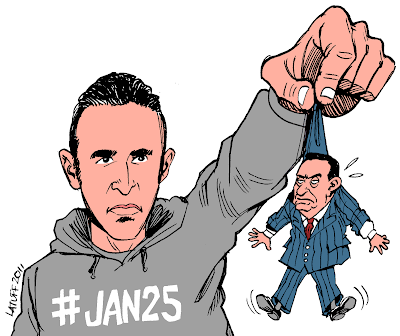
-Taken from the Guardian
-Cairo - January 2011
-Cartoon by Carlos Latuff, featuring Khaled Said and Hosni Mubarak

-Taken from the Guardian
-Cairo - January 2011
-Cartoon by Carlos Latuff, featuring Khaled Said and Hosni Mubarak
Egypt's authoritarian government is bracing itself for one of the biggest opposition demonstrations in recent years tomorrow, as thousands of protesters prepare to take to the streets demanding political reform.
An unlikely alliance of youth activists, political Islamists, industrial workers and hardcore football fans have pledged to join a nationwide "day of revolution" on a national holiday to celebrate the achievements of the police force.
With public sentiment against state security forces at an unprecedented level following a series of high-profile police brutality cases and the torture of anti-government activists, protest organisers are hoping that a large number of Egyptians will be emboldened to attend rallies, marches and flash mobs across the country in a sustained effort to force concessions from an increasingly unpopular ruling elite.
In a move that suggests the uprising in Tunisia may be spreading to other parts of the Arab world, Tunisian activists announced they would be holding their own protests in solidarity with their Egyptian counterparts, while many Egyptians plan to wave Tunisian flags. Parallel protests are also scheduled to take place outside the Egyptian embassies in London and Washington.
Demonstrators are calling for the sacking of the country's interior minister, the cancelling of Egypt's perpetual emergency law, which suspends basic civil liberties, and a new term limit on the presidency that would bring to an end the 30-year rule of President Hosni Mubarak, one of the Middle East's most entrenched dictators.
State security officials have branded the protests illegal, and said that those taking part will be dealt with "strictly".
"I'm answering a call that began online, a call to stand up against police brutality on the day the regime wants us to celebrate their so-called achievements," said Salma Said, a 25-year-old activist and blogger who plans to protest in Cairo.
"Of course demonstrating against police brutality means demonstrating against Mubarak himself and his whole regime, because they are the ones who created this system. Momentum is gathering really, really fast; friends I haven't spoken to in years have been ringing me up, promising to come down."
Tomorrow's events, dubbed a "day of revolution against torture, corruption, poverty and unemployment" by protest leaders, were initiated by two dissident movements, both based online. One is dedicated to the memory of Khaled Said, an Alexandrian man beaten to death by police last year, while the other, "6 April", is a youth group named after the date of an uprising two years ago in the Nile delta town of El-Mahalla El-Kubra, in which three people were killed by police.
After initially dismissing the protests, the Muslim Brotherhood - Egypt's largest organised opposition force - has now said it will back the demonstrations symbolically, although it has not called on its supporters to take to the streets. Strikes are expected by workers in several parts of the country, including Mahalla, and a number of Egypt's traditional opposition parties and prominent public figures have pledged support.
Mohamed Adel, a spokesman for 6 April, said the broad range of participants distinguished tomorrow's action from previous protests. "It will be the start of something big," he told the Egyptian news outlet Al-Masry Al-Youm.
In a sign of how seriously the Mubarak regime is taking any challenge to its authority following the downfall of Tunisia's president Ben Ali, counter-protests are being organised under the banner of "Mubarak: Egypt's security". Organisers say they want to express their rejection of the "destruction of state institutions" by the opposition, raising fears of violent clashes on the ground.
"Regardless of how many people turn up, these protests will be highly significant," said Nabil Abdel Fattah, a political analyst at the semi-official Al-Ahram Research Centre. "Those confronting the regime on Tuesday will be the sons and daughters of virtual activism - a new generation that has finally found something around which they can unite and rally.They are the product of a government that has never offered them any ideological vision to believe in, and now they have themselves become a symbol of contemporary Egypt."
Subscribe to:
Posts (Atom)


 Posts
Posts

